Footwork Fundamentals Transferred from Professional Tennis Courts to Soccer Pitches Among Premier League Defenders
Sofia Lorenz · Nov 4, 2026

Footwork Fundamentals Transferred from Professional Tennis Courts to Soccer Pitches Among Premier League Defenders
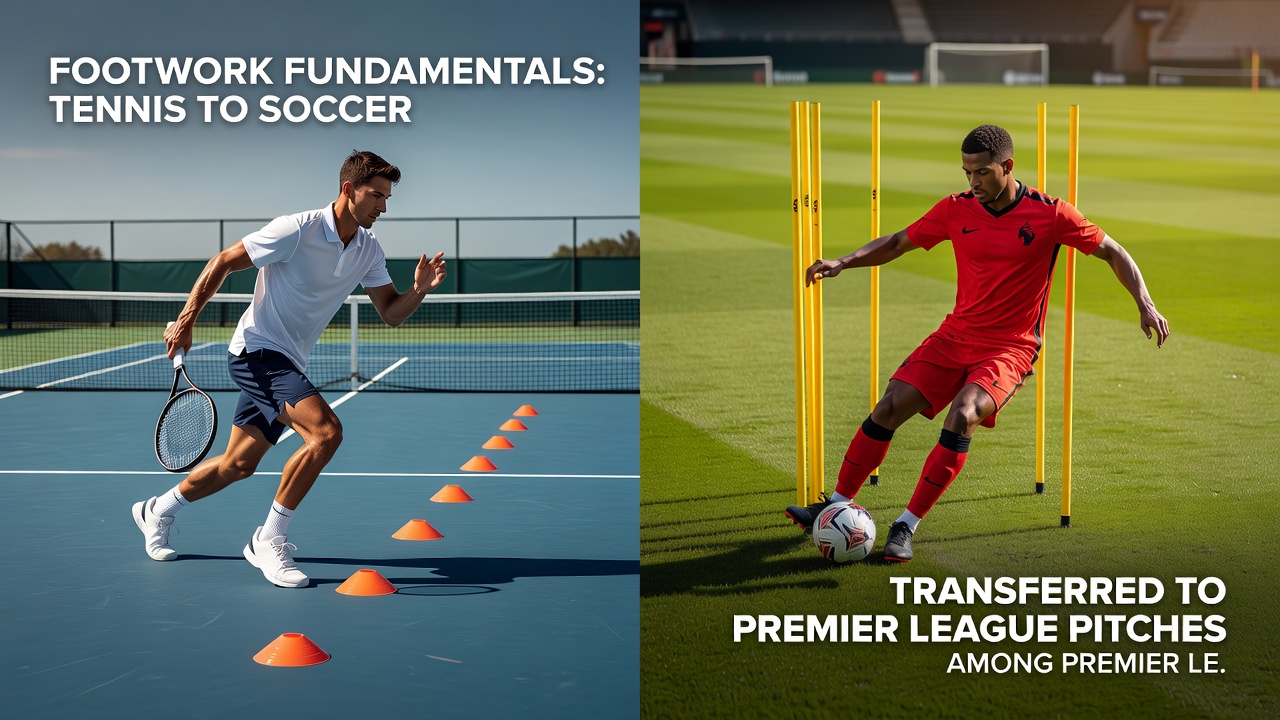
Premier League defenders have incorporated footwork patterns originally developed on professional tennis courts, where rapid directional changes and balanced recovery steps form core elements of player movement. Research from sports science programs indicates these adaptations appear in training sessions across multiple clubs, with data showing improved reaction times during high-pressure defensive actions. Observers note that the split-step technique common in tennis allows soccer players to maintain readiness for lateral shifts when tracking attacking runs, and figures from performance tracking systems reveal measurable gains in recovery speed among those who integrate the drills regularly.
Core Elements of Tennis Footwork Applied to Soccer
Professional tennis players rely on the split step to reset their base before each shot, a movement that creates explosive potential for side-to-side coverage, while soccer defenders face similar demands when marking opponents in tight spaces. Studies conducted by European sports institutes have documented how this same preparatory bounce translates to pitch conditions, where players must adjust for uneven surfaces and ball trajectories. Data from the 2025-2026 season shows defenders using these methods achieve faster deceleration and re-acceleration during one-on-one situations, and analysts attribute part of this consistency to repetitive tennis-derived drills that emphasize knee drive and hip rotation over straight-line sprinting alone.
Additional techniques include the crossover step for covering ground quickly and the open-stance recovery that keeps the body oriented toward the ball carrier. Premier League training staff have adopted modified versions of these patterns, often combining them with cone drills and shadow marking exercises. According to reports from academic research centers in Australia and Canada, such hybrid approaches produce measurable improvements in change-of-direction efficiency, particularly when defenders operate in the penalty area where space is limited and reaction windows shrink to fractions of a second.
Training Integration Across Premier League Clubs
Coaches at several Premier League teams introduced tennis footwork modules into preseason programs as early as 2023, with continued refinement through November 2026. These sessions typically begin with basic lateral shuffles drawn directly from tennis court routines before progressing to ball-specific applications on the pitch. Performance data collected by club analysts indicates that defenders who complete at least three dedicated sessions per week demonstrate higher success rates in tackles and interceptions during matches, and the pattern holds across different age groups and nationalities within the squads.
Video analysis tools now allow staff to compare defender movement against tennis player benchmarks, highlighting similarities in weight distribution and first-step quickness. One documented case involves a central defender whose lateral agility metrics improved after six weeks of focused tennis-style work, with the gains persisting through the mid-season schedule. Researchers at UK-based biomechanics laboratories continue to track these transfers, noting that the emphasis on soft landings and immediate reacceleration reduces the risk of certain lower-body strains while maintaining competitive intensity.
Performance Data and Seasonal Trends
League-wide statistics compiled through November 2026 reflect incremental gains in defensive actions that require rapid foot adjustments, such as blocking crosses and recovering after being beaten on the dribble. Figures released by performance analytics providers show clubs that emphasize cross-sport footwork reporting fewer instances of being outmaneuvered in wide areas compared to previous campaigns. Academic papers from North American universities have examined similar transfers in other team sports, and the principles align closely with observed Premier League patterns where balance and directional control determine outcomes in tight contests.
Equipment modifications, including lighter training shoes modeled on tennis footwear, further support these adaptations by allowing quicker ground contact times. Data indicates that defenders wearing such models during practice sessions maintain higher movement frequencies without increased fatigue markers. The combination of technique and equipment appears across multiple squads, and longitudinal studies suggest the benefits compound when integrated consistently rather than applied sporadically.
Conclusion
Footwork principles originating in professional tennis continue to influence defensive training in the Premier League, with measurable effects on player movement and match performance through the 2026 season. Ongoing research from international sports science organizations supports the value of these transfers, and clubs maintain the programs as part of broader athletic development strategies. The patterns demonstrate how targeted technique sharing across sports can address shared physical demands without requiring wholesale changes to existing soccer methodologies.